DETECTION
OF RADIOACTIVE CONTAMINATION, USING
GEIGER-MOLLER COUNTERS
By Leon F. Curtiss
RESEARCH PAPER RP1223
Part of Journal of Research of the National Bureau of Standards, Volume
23,
July 1939
|
Situations
frequently arise in which it is desirable to determine the extent of
accidental contamination by radioactive materials. Such contamination
occurs in research laboratories where radioactive studies are in
progress and also in
commercial plants where radioactive materials are handled. An important
example of the latter is the dial-painting plants, where self-luminous
radium
paint is applied.
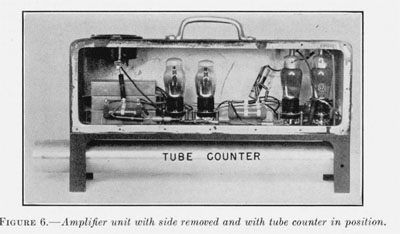
This article describes a portable Geiger-Miiller counter operated
entirely from
the alternating-current mains, which permits a rapid and accurate
determination
of such contamination wherever it exceeds the equivalent of about
one-half microgram of radium per square meter. The device is also
sufficiently sensitive to determine the presence of radium in amounts
of micrograms in a living person and therefore may be used for routine
test of workers, their garments, and objects habitually
handled by them. The instrument is very rugged, readily portable, and
silent in
operation. Requiring no batteries of any kind, it is always ready for
use. Commercial radio parts are used well within their ratings
throughout, with the exception of the tube counter itself, so that
there is little danger of failures, and the parts are easily replaced
if they should fail. The indicator is a milliammeter, which is
arranged to have a very steady deflection under constant conditions and
is yet
sufficiently sensitive to measure 1 microgram of radium at a distance
of 1 meter.
The device may therefore be used for intercomparison by gamma radiation
of
samples of radium of low activity. It has been tested under practical
conditions and has been found well suited for surveys of contaminated
locations. It
also is a very sensitive detector for finding lost radium preparations
and for
testing radium ores for commercial value. |